Showing posts with label New Pregnancy. Show all posts

APGAR Scale Test

Best Blogger Tips 0 comments

http://kidshealth.org/parent/pregnancy_center/q_a/headers_79529/Papgar_score.jpg
APGAR Scale Test
As soon as your baby makes his or her grand entrance into the world, she will be given an APGAR test. This test helps your doctor or midwife to evaluate your baby's condition and determine if he or she needs any treatment. It is quick and painless, and if the test indicates your baby is in distress, doctors can administer necessary medical attention immediately.

The APGAR scale and testing methods were developed in the 1950s by noted obstetric anesthesiologist Dr. Virginia Apgar. Your baby is first tested one minute after birth to determine how well he or she experienced the birth process, and then again at five minutes after birth, to determine how well he or she is adjusting to life outside the womb or responding to any medical procedures.

The test is not only named after Dr. Apgar, it is also an acronym for the five characteristics on which your baby is tested: Appearance, Pulse, Grimace (reflex response), Activity (muscle tone), and Respiration. Your baby is given a score between zero and two for each characteristic and then the scores are combined. Very few babies score a perfect ten - even perfectly healthy ones - particularly at the one minute test. A score of between 7 and 10 indicates your baby is in good shape and doesn't require any extraordinary medical attention, while a score between four and six indicates your baby is in fair condition and may need some help breathing. The nurse or pediatrician may administer oxygen under your baby's nose or vigorously rub her skin to aid circulation and respiration. If your baby scores under four, she is considered to be in poor condition and may require more serious, immediate measures such as oxygen administered from an oxygen mask.

The following is a breakdown of the APGAR scale:


Appearance
0 - Baby's entire body is bluish-gray or pale
1 - Baby's body has good color, with a bluish tinge to the feet or hands
2 - Good color over entire body


Pulse
0 - No heart beat
1 - Fewer than 100 beats per minute
2 - More than 100 beats per minute


Grimace
0 - No response when airways are suctioned
1 - Baby grimaces during suctioning
2 - Baby grimaces and pulls away, coughs, or sneezes during suctioning

APGAR Scale Test


Activity
0 - Baby is limp, no detectable movement
1 - Baby displays some flexing of arms and legs
2 - Baby moves vigorously


Respiration
0 - Baby is not breathing
1 - Baby cries weakly, may sound like whimpering, with slow or irregular breathing
2 - Baby cries strongly, with a normal rate and effort of breathing


Even if your baby has a low score at one minute doesn't mean that he or she won't be perfectly healthy eventually. Many babies who are delivered via c-section, a difficult labor and delivery, or who are premature have lower-than-normal initial scores, but recover fully.

The APGAR test is an invaluable part of your baby's first moments and can ensure that he or she receives critical medical attention in the event of a low score.


Respected Readers:
Need your help to keep the site up and running. please donate ! Any help is appreciated.

Amniotic Fluid

Best Blogger Tips 0 comments

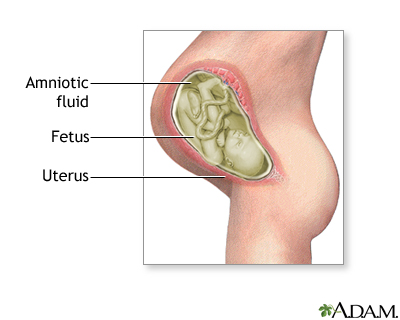
http://www.nlm.nih.gov/medlineplus/ency/images/ency/fullsize/9058.jpg
Amniotic Fluid
Amniotic fluid is a colorless liquid made of water, fetal skin cells, and fetal waste, and is contained within the amniotic sac or "bag of waters" that surrounds your baby. This buoyant fluid not only protects and cushions your baby, it helps your baby grow uniformly, helps bones and muscles develop, allows your baby to move within the uterus, and keeps the walls of the amniotic sac from sticking to your baby. Your baby also breathes this fluid in and out while still in the womb, helping his lungs to grow. By the end of your pregnancy, there is approximately one quart of amniotic fluid surrounding your baby.

For the first four months or so of your pregnancy, the placenta produces amniotic fluid; but after your baby's kidneys start to function, they take over amniotic fluid production for the remainder of the pregnancy. The fluid is constantly circulated as your baby "breathes" and swallows it and then excretes it as urine. However, amniotic fluid is not urine as we know it; the majority of your baby's waste is actually removed through the placenta and is then filtered by your kidneys.

An excessive amount of amniotic fluid is called polyhydramnios, and is often associated with a multiple pregnancy (twins or triplets), congenital anomalies, or gestational diabetes. An abnormally small amount of amniotic fluid is known as oligohydramnios, and may the result of a postdate pregnancy, ruptured membranes, placental dysfunction, or fetal abnormalities.

Many women believe that their water will break just before going into labor, signaling its onset; but this is usually not the case. In fact, only 10 percent of pregnant women's water breaks before their labor begins. Most women's water doesn't break until they are at the hospital in active labor. Indeed, it can occur anytime from the onset of labor to birth and sometimes the doctor must manually break the sac.

When your water breaks, you might notice anything from a slight dampness or small trickle of water, to a gush of fluid from your vagina. The fluid should be clear and non-odorous. If you suspect your water has broken, call your doctor and report the color, odor, quantity of fluid, and time of the break. If your water breaks or develops a small tear before your baby is ready to be born, it can cause serious complications. Premature Rupture of Membranes, or PROM, can cause infection, premature labor and birth. In some cases, however, the sac heals itself and the pregnancy can progress until full-term.


Respected Readers:
Need your help to keep the site up and running. please donate ! Any help is appreciated.

Anemia

Best Blogger Tips 0 comments

http://www.cauliflowerrecipes.co.uk/wp-content/uploads/Pregnant-woman-eating-str-001.jpg
Anemia
Iron is a necessary nutrient for a healthy body, especially when you are pregnant; yet 20 percent of pregnant women don't get enough iron, which can lead to a low red blood cell count, or anemia. Before you became pregnant, you needed 15 milligrams of iron a day; but now your daily requirement has doubled to 30.

During your pregnancy, you have twice as much blood flowing through your body to support your growing baby, and you need extra iron to make more hemoglobin for all that new blood. Hemoglobin is the protein in your blood that carries precious oxygen to your body's tissues and growing baby.

If you become anemic during pregnancy, you may become excessively fatigued; have a tendency to get stressed and sick; or develop a pale complexion, shortness of breath, fast or irregular heartbeats, weakness, dizziness, light-headedness, or fainting spells. If your anemia is very severe, your baby's growth may slow and you may be at risk for premature delivery. And if you are anemic when you deliver, it may be difficult for you to recover from the loss of blood, an infection, or other possible complications of delivery.

You may also become anemic if you have a folic acid or vitamin B deficiency, lose a lot of blood from an injury or surgical procedure, or if you have a chronic illness such as kidney disease.

Your caregiver probably tested you for anemia at your first prenatal appointment and will continue to test you at every appointment thereafter. He or she will probably recommend you take a prenatal vitamin that contains iron as a preventative measure against anemia, and if you develop anemia sometime during your pregnancy, it will probably be treated with an iron supplement. Taking an iron supplement may make your morning sickness worse and can cause constipation, so try to drink more fluids and take the supplement at night before going to bed to minimize your discomfort. Do not take an iron supplement with milk as it can prevent the absorption of iron.

To prevent anemia, eat foods that are high in iron, such as red meat, dried beans, leafy green vegetables, dried fruits, and fortified breads, pastas, and cereals. In addition, be sure to get plenty of vitamin C (which aids iron absorption), vitamin B, and folic acid.


Respected Readers:
Need your help to keep the site up and running. please donate ! Any help is appreciated.

Antibiotic Safety

Best Blogger Tips 0 comments

http://www.ecdc.europa.eu/en/press/news/PublishingImages/Antibiotic_capsules_small_sm.jpg
Antibiotic

A normal, healthy pregnancy is sometimes complicated by an infection that requires treatment with antibiotics. Everything from a routine urinary tract infection to a sexually transmitted disease can put your and your baby's health at risk. However, an antibiotic's safety depends not only on the characteristic of the drug itself, but also how much is taken, for how long, and during what stage of pregnancy.


Antibiotics are often given to women during labor if they have tested positive for Group B Strep, if they are in preterm labor, or if their membranes rupture and the baby is not delivered within 18 hours. Pregnant women may also receive antibiotics if they have a high fever, if the fetus's heart rate exceeds 160 beats per minute, or if the amniotic fluid is malodorous.

Antibiotics may increase the likelihood that your baby develops a fungal or yeast infection or experiences diarrhea, which can lead to dehydration. While these conditions do not pose a risk to healthy full term babies, they can be dangerous for stressed or preterm babies.

In a study reported in the American Journal of Obstetrics and Gynecology, the babies of mothers who received some type of antibiotic during their pregnancy or labor were less able to fight off infection, and almost half of them were resistant to ampicillin, a penicillin-like antibiotic. However, antibiotics should not be withheld if the woman needs them. In some cases, the risk of not treating a condition with antibiotics outweighs the risk of exposing the fetus to the medication. You should always discuss the situation with your doctor, and weigh the risks and benefits to determine what is best for you and your baby.

Some antibiotics are safe to take while you are pregnant, some pose a risk to the fetus, and many fall somewhere in between depending on when and how much you take. There are dozens of types of antibiotics, but some of the most common that are considered safe to take during pregnancy include:
  • Penicillin
  • Cephalosporin
  • Erythromycin
  • Metronidazole - Some experts used to suspect a link between metronidazole and birth defects. However, new studies have not supported this theory and it is considered safe in most cases.
Some types of antibiotics that should be avoided during pregnancy include:
  • Streptomycin - used to treat tuberculosis. This can cause hearing loss in your baby.
  • Tetracycline - used to treat acne and respiratory infections. If taken in the first trimester, there is a small risk of birth defects. However, if taken in the second or third trimester, it may discolor your baby's teeth.
  • Trimethoprim - used to treat urinary tract infections. It blocks the effects of folic acid. If you must take this antibiotic during your pregnancy, be sure to take your daily prenatal vitamin as well.
Always let your doctor know you are pregnant before he or she prescribes any medication, and check with your obstetrician or midwife before taking any new medication prescribed by another physician.


Respected Readers:
Need your help to keep the site up and running. please donate ! Any help is appreciated.

Pesticide exposure in womb may hurt your child's IQ

Best Blogger Tips 0 comments

Pesticide exposure in womb may hurt your child's IQ

Experts stress, however, that pregnant women should not stop eating fruits and vegetables.


Children whose mothers are exposed to high amounts of certain pesticides while pregnant appear to have lower IQs than their peers when they reach school age, according to three government-funded studies released today.


The pesticides, known as organophosphates, are commonly sprayed on food crops and can be found in trace amounts on berries, green beans, and other fruits and vegetables sold in stores. The pesticides have also been used in homes and gardens, although their indoor use has been widely restricted due to safety concerns.


Organophosphates, which kill pests by attacking the nervous system, have previously been linked to developmental delays and attention problems in young children who were exposed in the womb. Now, researchers in two different locations have found that a child's IQ tends to decrease in proportion to the mother's exposure while pregnant.

One of the studies followed hundreds of mostly Latino mothers and children in California's Salinas Valley, a center of commercial agriculture. Many of the women were farmworkers, or had family members who worked on farms.


When the women were pregnant, the researchers tested their urine for several chemical by-products of organophosphates -- a standard means of gauging exposure. The mothers with the highest levels of by-products, known as metabolites, had children whose IQs at age 7 were seven points lower, on average, than the children whose mothers had the lowest levels of exposure. (The average score is 100.)

"That's not unlike the decreases we see in children with high lead exposure," says the senior study author, Brenda Eskenazi, Ph.D., a professor of epidemiology and maternal and child health at the University of California, Berkeley. "It's equivalent to performing six months behind the average."


The children's own metabolite levels were not linked to their IQs, however, which suggests that prenatal -- rather than childhood -- exposure is largely responsible for the trend, Eskenazi says. Organophosphates, which pass from the mother to fetus through the placenta and umbilical cord, may be more damaging to developing fetuses than to children, the study notes.

Similar trends are likely to be found outside farming communities, the researchers suggest. While the average metabolite levels of the pregnant women in the study were substantially higher than the national average, as many as 25% of pregnant women in the general population have levels above the study average.


Moreover, the findings are echoed by a second study released today, which was conducted in New York City and followed 265 black and Dominican mothers and children from low-income families.

In that study, researchers measured levels of the organophosphate chlorpyrifos in the women's umbilical cord blood. Chlorpyrifos, which has since been banned for indoor use, was still commonly used as a residential pesticide when the women were pregnant.

Using the same IQ test as the California study, the researchers found that when the children were 7, the IQs of those with the highest exposure in the womb was roughly three points lower, on average, than those with the lowest prenatal exposure.

The joint findings are strengthened by the differences in the locations, study participants, and methods used to measure pesticide exposure, says Bruce Lanphear, M.D., a professor of health sciences at Simon Fraser University, in Vancouver, British Columbia. "Because the results are so consistent, we're more confident that the results are not spurious," says Lanphear, who was not involved in the research.
In both studies, the researchers sought to cancel out other factors that can affect a child's IQ. They controlled for the mother's education and income, and observed the stimulation provided by the child's home environment. The California study also factored in the mother's exposure to lead and toxic flame retardants.


Experts aren't sure how organophosphates might interfere with fetal brain development, although they do know that in insects the pesticides slow the breakdown of acetylcholine, an important neurotransmitter.

"There have been a lot of studies that indicate that there are probably other mechanisms," says the senior author of the New York City study, Robin Whyatt, DrPH, a professor of clinical environmental health sciences at Columbia University's Mailman School of Public Health.


Genes may play a role, in fact. In the third study, which also looked at children in New York City, researchers found that the association between organophosphate exposure and developmental delays was more pronounced in children whose mothers had a certain genetic variant that influences an enzyme that breaks down organophosphates.


The three studies appear in the April 21 issue of the journal Environmental Health Perspectives. All three were funded by grants from the Environmental Protection Agency and the National Institute of Environmental Health Sciences, among other sources.

The average exposure to organophosphates is lower today than it was when these studies began a decade ago. Now that the indoor use of organophosphates has been all but eliminated, the main sources are direct exposure to commercial agriculture and the traces found on supermarket produce.


Eskenazi stresses, however, that pregnant women should not stop eating fruits and vegetables. "It's absolutely important that they have an adequate diet in terms of the health of their child," she says.

Still, she adds, "It's important that people wash their fruits and vegetables really, really well -- and that means even fruit with a peel on it. It should be washed before you peel it."


Respected Readers:
Need your help to keep the site up and running. please donate ! Any help is appreciated.


Moms Angels Copyright 2011 All Rights Reserved | Powered By Amader IT