Showing posts with label Toddlers. Show all posts

Teaching Self-Control

Best Blogger Tips 0 comments

http://thedrilldown.com/wp-content/uploads/2010/10/mom-scold-toddler.jpg

When kids melt down in the middle of a crowded store, at a holiday dinner with extended family, or at home, it can be extremely frustrating. 

But parents can help kids learn self-control and teach them how to respond to situations without just acting on impulse.

Teaching self-control skills is one of the most important things that parents can do for their kids because these are some of the most important skills for success later in life.


Helping Kids Learn Self-Control

By learning self-control, kids can make appropriate decisions and respond to stressful situations in ways that can yield positive outcomes.
For example, if you say that you're not serving ice cream until after dinner, your child may cry, plead, or even scream in the hopes that you will give in. But with self-control, your child can understand that a temper tantrum means you'll take away the ice cream for good and that it's wiser to wait patiently.
Here are a few suggestions on how to help kids learn to control their behavior:

Up to Age 2

Infants and toddlers get frustrated by the large gap between the things they want to do and what they're able to do. They often respond with temper tantrums. Try to prevent outbursts by distracting your little one with toys or other activities. For kids reaching the 2-year-old mark, try a brief timeout in a designated area — like a kitchen chair or bottom stair — to show the consequences for outbursts and teach that it's better to take some time alone instead of throwing a tantrum.

Ages 3 to 5

You can continue to use timeouts, but rather than enforcing a specific time limit, end timeouts once your child has calmed down. This helps kids improve their sense of self-control. And praise your child for not losing control in frustrating or difficult situations.


Respected Readers:
Need your help to keep the site up and running. please donate ! Any help is appreciated.

Dealing with Toddlers

Best Blogger Tips 0 comments

http://activitiesfor2yearolds.net/wp-content/uploads/2011/04/8.1-toddler-Activities.jpg


Parenting Strategies With Toddlers

A number of recent workshops with parents of toddlers produced the following list of ideas and key points to keep in mind when facing the challenge of parenting children whose life space is dramatically expanding but whose verbal skills and concepts of time, place, and consequences are still quite limited.

Visual aids are very helpful in establishing the sense of sequence and time for the behaviors required to start and end the day. Charts with drawings or pictures that have clock faces next to them enable the child to more quickly grasp the specific steps needed to complete the process but also begin to learn the importance of sequence and time in completing complex tasks. Parents must remember how complicated getting ready to leave the house is for a 2 year old. There are so many steps to be mastered and so-o-o many distractions. Plus, "What's a '5 minutes'?". We talk time to very young children which is one of the most abstract concepts in life.

Speaking of time, transitions are another major challenge for young children. At the end of a workshop, one mother went into the classroom to get her child and go home. The child resisted. The mother had been mentally preparing to leave. The child had not. Children need warnings, often a few of them, to begin to wind down and finish an activity. Toddlers will often need the parent to enter the activity in order to ease the child out of it. Making a game of cleaning up or creating an ending helps as does distractions that begin to shift the child's attention to change and transition. It can be helpful to talk about what will be happening when you leave, especially if it involves the child in actively making some decision about what will happen at the next stop, e.g., what book she would like you to read that night.

More about time goals: use timers to give children a visual, concrete focus and often make a game out of it. Can you brush your teeth or get your clothes on before the bell rings? One mother had success laying out options of sets of outfits plus beating the timer for a child who was having a lot of trouble getting dressed in the morning. Parents also need to be careful of taking too much responsibility for getting the child ready in the morning. Taking a child to preschool in his/her pajamas with clothes in a bag is often a very powerful way to underscore that you cannot control your child's behavior but you can control consequences. If you get drawn into believing that it is up to you to make sure everything is in perfect order before leaving than your toddler is training you rather than vice versa.

Whenever you are trying to say something important to a young child, kneel down and say it softly, eye-to-eye. Parents often attempt to give directions/orders/make requests from a distal position rather than a proximal one. But very young children cannot focus their auditory sense on a distant object when it is competing with an ongoing tactile or visual experience. Don't call out from the next room and expect more than about two seconds of attention. Even being next to a child but emitting words that are more than three feet from the ears, and more importantly, without the requisite visual or tactile attention, limits your effectiveness in getting attention and getting the message across. Even with older children in a classroom, a teacher walking about the room simply touching the shoulder of an inattentive child can dramatically improve being heard.

A biting 2 year old? Eye-to-eye - a very firm "No!", immediate BUT quiet removal, and consistent repetition. Don't waste time lecturing toddlers!

A toddler being mean to a new baby. Again the eye-to-eye "No!", but this time you should add a brief comment that it IS hard to have to share attention with a new baby, while you pick up the baby and go off, negating the toddler's attempt to gain negative attention by having you focus on punishing him.
Distraction is one of the most helpful strategies. Also parents need to use their knowledge and anticipate situations when a toddler may have difficulty or cause a problem, e.g., the child who interrupts whenever you are on the phone or the slow-to-warm up child who resists or runs out of patience in a group activity. Always have some interesting object that will hold the child's attention for a few minutes (an object not otherwise available for the child to play with) or have a favorite book and read to the child for a little while until she is able to enter or re-enter the social situation. One mother, whose son was physically hitting children in group play, realized the child would give her a clue by coming over and clinging when he couldn't tolerate the intensity of the social play of the other children. Her son needed a time out, in a positive sense, and once they worked out the signals, she would call him over for some quiet time before an incident occurred.

Some toddlers have hypersensitive sensory systems. They react with distress to loud noises, can't tolerate physical closeness (don't relax when you hold them; lash out when children are suddenly in their face), reject foods and clothing that don't "feel right" in their mouths or against their skin. These are valid issues. Treat them as such by developing accommodations and not worrying they won't turn out all right.

Toilet training is a constant concern when it need not be. Gently encourage the child when she appears to be interested but if not ready, be patient. It will occur in due time. And loss of control is quite common. Don't expect once mastered that the issue is forever gone.

Hyper children are a challenge to get to sleep. They have difficulty calming their systems to the point of being able to fall asleep. They will need more gentle rocking, sucking, and rhythmic sounds as aids to falling asleep and are less likely to be able to fall back to sleep if they wake up during the night. Try brief interventions but the reality is that some children will need your bodily presence to regain control of their own biological rhythm.

Keep in mind that toddlers are not in training to be miniature adults. Parents and teachers often put too much stress on training very young children to cope by using words when developmentally they are more skilled at learning to cope through action and tactile/visual modalities. Let them be toddlers. And enjoy the process. It really passes very quickly.


Respected Readers:
Need your help to keep the site up and running. please donate ! Any help is appreciated.

Saying No to Vegetables!!

Best Blogger Tips 0 comments

http://scientopia.org/blogs/childsplay/files/2010/08/not-eating.jpg
It is usually difficult to convince children that vegetables are good for them. Here are a couple of ideas to get them to eat vegetables - often they won't even know that they are eating vegetables.

It's an age-old problem - children who refuse point-blank to eat vegetables. You as the parent want to pull out your hair with frustration. You know how important it is for your child to eat vegetables, but no matter what you say, the green beans, carrots, broccoli are always left uneaten.

You can try to make them feel guilty by telling them about the millions of starving children in the world, but you probably know by now that this has no effect on your child and anyway, it's not healthy to cultivate feelings of guilt in your children.

Here are some ideas to get them to eat vegetables:


Fruit instead of vegetables:

You may find that the child, who hates vegetables, loves fruit. Make sure that you always stock up on fresh fruit and that they are easily accessible to your children.

Carrots:

Children, who prefer fruit to vegetables, usually love raw carrots. Encourage them to eat as many as they want. Another idea with carrots is to peel them and then cut into julienne strips. Serve as is, or with a small tub of plain yogurt.

Gem Squash:

This is one of the few vegetables that children really like. Once the gem squash is cooked, place a blob of butter in each gem squash half and serve. Or place a tablespoon of peas in each gem squash half.

Vegetable juice

Fresh and pure vegetable juice can be bought at most supermarkets and most children love them. It's one of the easiest ways to get them to take in vegetables.

Chinese Stir Fry:

Use cabbage, carrots, bean sprouts, celery and baby marrows. Wash and cut the vegetables into strips. Heat a tiny bit of oil in a wok or a large saucepan. Add the vegetables, except for the bean sprouts and stir-fry for about 7 minutes. Add the bean sprouts and stir-fry for another 3 - 5 minutes. Remove from heat and add Soy sauce to taste. Serve and let the children use chopsticks to eat their vegetable stir-fry.

Pasta Sauce

This could easily be your best-kept secret - the sauce that goes over the pasta is made from vegetables. Take any vegetable, cook it. Put all the vegetables into a blender, add tomato paste or raw tomatoes and blend till a paste is formed and more importantly, there are NO traces of vegetables. Heat on the stove and when ready, pour over the pasta. Try carrots, green beans, in fact any vegetable that your child will not normally eat.

Cabbage

This is a difficult one - few children like eating cabbage. Try grating raw cabbage and adding mashed guava and finely grated carrots. Add 1 teaspoon of sugar (use brown sugar if preferred) and mix. Stir in a small about of mayonnaise and place in the fridge until required. Optional: stir in chopped nuts and raisins into the salad just before serving. 


Spinach

The best method I know is to use cooked spinach and blend it. Make pasta (flour, eggs, salt and milk) and before rolling out the dough to form pasta strips, stir in the blended spinach - instant and cheap lasagne.

Potatoes

Potatoes have to be the most popular of vegetables. Children will eat potatoes in most forms - from French fries, to roast potatoes to mash. A hugely popular dish is to peel and chop up an onion. Brown the onion over a low heat in a tiny bit of oil. Peel and thinly slice your potatoes. Place the browned onions at the bottom of a casserole dish. Place a layer of potatoes on top, followed by a layer of gravy powder and then dot with small pieces of butter. Place another layer of potatoes, followed by gravy powder and butter. Continue doing this until all the potatoes are finished. Grate about ½ cup of cheese and sprinkle over the top. Place in a moderate oven and bake for about 1 hour.

Tomatoes and cucumbers

Peel and slice tomatoes and cucumbers. Boil eggs. Place the eggs, tomatoes, cucumbers and about a small amount of mayonnaise into a food processor. Blend until finely chopped. Serve this mixture on bread or toast.

Broccoli

The best way to serve broccoli to children is in a white sauce and over a baked potato - simply the most delicious way to eat baked potatoes.


Respected Readers:
Need your help to keep the site up and running. please donate ! Any help is appreciated.

Helping Moms Through Stressful Times

Best Blogger Tips 0 comments

http://www.adventurousmom.com/wp-content/uploads/2010/03/iStock_000011105868XSmall-300x199.jpg
Does your little one refuse to eat dinner? Shriek at the sight of her car seat? Insist on wearing the same dirty sweatshirt for the fourth day in a row?
Whether it's during the morning routine, at bedtime, or somewhere in between, every mom has her tear-your-hair-out moments when her kids just will not cooperate.
There are no one-size-fits-all solutions for these hardest times of the day, but that doesn't mean you're on your own. 


Here are some mom-tested techniques – dozens of helpful little tricks to make life run a little more smoothly.

Refusing to get out of bed

I play high-energy music softly at first and then gradually go louder and louder. If my kids continue to play dead, I jump on their beds until they abandon ship. A little exercise wakes me up as well.
Tickle your kids gently under the arms; kiss them repeatedly; or, my favorite, sing a song really badly and say that you won't stop until they start getting dressed.
Make sure your child is getting enough sleep – move bedtime up a half hour and see if that helps!

Tantrums about getting dressed

This is an extreme measure, but sometimes I have my child get dressed the night before and sleep in what she's going to wear the next day. Before bed, have your child lay out clothes for the next day – everything down to socks and undies. No switching outfits in the morning, either! Limit options. My daughter has only two pairs of shoes, and it's enough.

If your preschooler is picky about what she wears, get her involved in buying her own clothes. I almost always get my 4-year-old's approval before buying so she'll wear the stuff without a battle. I shop online sales with her on my lap. It's easier than going to stores.

I stopped caring about what my kids wear – as long as they're weather- and play-appropriate, anything goes.
To motivate my son, I have him race against me to see who can get dressed first. The "Grandma (or Auntie, or teacher) doesn't think you can get dressed all by yourself" line can work magic!

My rule is that kids must be dressed to eat breakfast. Yes, it can lead to more laundry, but it's worth it.
Threaten to leave the house as-is – in underwear and one sock, for example. Have clothes ready to take with you (or in the car) in case your child calls your bluff. Sometimes I just put clothes on them however I can. I've had to sit on my daughter to get her dressed. I don't like to, but sometimes there's no time for negotiation.
Give up for a few minutes and distract, then try again.

Crazy, rushed breakfasts

Lay out everything you'll need the night before: bowls, cereal, fruit, paper napkins, silverware.
Have your kids eat in the car to save time. Good to-go breakfasts include granola bars, frozen waffles (no syrup, of course), cheese sticks, fruit, or nuts. Let your kids do as much for themselves as they can – pour cereal and milk, get their own spoons and napkins, and so on. Keep kids seated by instituting the "once you're up, you're done" rule.

Not wanting to leave the house

Give your child ten-, five-, and two-minute warnings so they know what to expect and don't feel blindsided.
Use a timer to signal when you need to head out the door.
Try to do the same things in the same order every morning so your child knows what's coming when.
I count to five and if she makes it to the front door before I'm done counting, she gets a treat (usually dried fruit) in the car. Whenever possible, turn tasks into a game.

Struggling against the car seat

It's all about the gummy bears. Yes, I bribe him to get in his car seat. My daughter hates her car seat and is too young to understand why she has to sit in it. I have to force her in some mornings – it's my only option.
I keep a pack of sugar-free gum in the car (for older kids only!). Once they are buckled in, they can have a piece. No car seat, no gum.

Get the police involved. Let your child know that it's not you insisting on the car seat, it's the cops.
Whichever child gets buckled up first gets to pick the music or story we listen to in the car.
Keep a doll car seat in the car and let your child strap in the doll first. Be sure to praise her for being such a good parent.

Public tantrums, meltdowns, and fussiness

http://www.ayushveda.com/womens-magazine/wp-content/uploads/2010/07/Toddler-Tantrums.jpgA mental trick can help: I pretend my daughter is someone else's child. That somehow makes the epic battles less personal. Keep earplugs in your purse. Without the noise, it's easy to be kinder and to deal with your child with patience. The best advice I've gotten is to lean into them with love, kindness, and patience when they're freaking out (pretty much counterintuitive). This doesn't mean giving in, but rather giving them space to have big, big feelings, as horrible as it can be. It works magic on a good day. On a bad day, it's just a bad day.

I try to counter intense and high-energy moments with the opposite: I go totally low-key, mellow, slow. It brings everyone's energy down to a livable level.  Distract! I'll look suddenly at something in the distance and say something like, "Oh my gosh, is that a giant pink bunny?" It stops my daughter in her tracks and redirects her attention. Then I can spin it into a fun story about what the pretend bunny was doing.

For my older kids, I say, "You get what you get and you don't throw a fit." Sometimes it's the only response.
Let kids know what's expected of them before they get to meltdown stage. Get down on their level and explain, calmly, what they need to do. When all else fails, use "incentives" (otherwise known as bribes).

Our rule is that the kids must try a bite of what I make, but if they don't like it after trying, they can have a peanut-butter sandwich instead. Nice comments are always welcome. If you have something negative to say about the meal, keep it to yourself. If after trying their dinner they decide they don't like it, the replacement dinner is one they make themselves – usually a bowl of cereal.

Children who are crying or throwing a tantrum are not allowed to be in the same room with people eating. They can join the family when they're done. Buy kid-friendly chopsticks that are connected at the top and play "I bet you can't pick up a [vegetable]!" When they succeed, play "I bet you can't get it into your mouth!" The bonus is that the chopsticks help build their fine motor skills. 

Don't cook separate meals for your kid, just serve meals with at least one food you know they like (like bread and butter). Try the "you don't have to eat it, but the next meal is breakfast" rule.
If possible, bring in reinforcements (aunts, uncles, older siblings, babysitters) to encourage your kids to try new things at meals. Sometimes they're more convincing than parents.

Refusing to eat or complaining about the meal

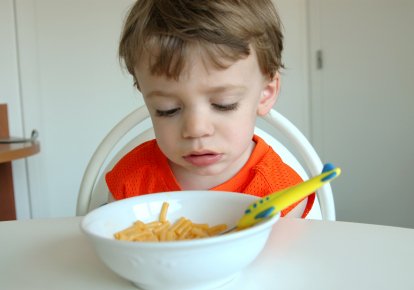
Our rule is that the kids must try a bite of what I make, but if they don't like it after trying, they can have a peanut-butter sandwich instead.
Nice comments are always welcome. If you have something negative to say about the meal, keep it to yourself.
If after trying their dinner they decide they don't like it, the replacement dinner is one they make themselves – usually a bowl of cereal.
Children who are crying or throwing a tantrum are not allowed to be in the same room with people eating. They can join the family when they're done.
http://health.more4kids.info/uploads/Image/picky-eater.jpg
Buy kid-friendly chopsticks that are connected at the top and play "I bet you can't pick up a [vegetable]!" When they succeed, play "I bet you can't get it into your mouth!" The bonus is that the chopsticks help build their fine motor skills. 
Don't cook separate meals for your kid, just serve meals with at least one food you know they like (like bread and butter).
Try the "you don't have to eat it, but the next meal is breakfast" rule.
If possible, bring in reinforcements (aunts, uncles, older siblings, babysitters) to encourage your kids to try new things at meals. Sometimes they're more convincing than parents.

Won't help with cleanup

Use music to motivate your kids during clean-up time. Pick a special song to play or sing.
If you act like it's fun, they will too.
Make cleanup easy by using bins or baskets to throw everything in.

Resists getting ready for bed, bath time, or hair-brushing

When my daughter was about 3, I would take one of her stuffed animals or just pretend to be someone else (usually in a child's voice) and ask her to teach me how to brush teeth and put pj's on. She loves to tell others what to do – she comes by it honestly – and she would get really into it. That's how we'd get through the whole bedtime routine.
http://www.yummymummyclub.ca/UserFiles/Image/photo_sleep(1).jpgThirty or 40 minutes ahead of time, I tell them what time lights-out will be. The faster they get ready, the more reading time we have. I tell them I'm ready and I read a magazine until they're ready (or ready for help for the younger one). The calmness really helps. I like this method because it's win-win for me – if they hurry, we get to read for a long time, and if they don't, I get to enjoy my magazine. I don't do this every night, just when there is resistance brewing.
During bath time I pretend to be Flo, the salon owner. I speak in a Southern accent and tell her it's time for her services. She'll let Flo wash her hair and we chat it up like she's at a real salon.
My daughter has long hair and brushing it was a challenge, to say the least. When she would rage at me for pulling it, I would pleadingly call Tinker Bell in to put some fairy dust on her. This would calm her down. The theme: fantasy. We could get through anything if we employed our imaginations and kept our senses of humor.
Shampooing once or twice a week is just fine. And we only have a bath every other night.
Use conditioner even if your shampoo is a 2-in-1. It makes combing so much easier. I like leave-in conditioner because it's one less step in the bath.
When we started having hair-brushing battles, I convinced my daughter to cut her hair short. She likes it, and it's much easier to care for.

Refusing to go to bed (in their own bed)

Same bedtime, same routine, every single night. No surprises. No exceptions. Everyone knows what to expect.I set up rules before bedtime and repeat myself over and over saying, "You can't sleep in our bed, but I'd be happy to give you a hug and carry you back to your bed and tuck you in."
My daughter always wanted me to stay in her bed. I would lie down with her but set a timer for five minutes and kiss her and leave when it went off.


Respected Readers:
Need your help to keep the site up and running. please donate ! Any help is appreciated.

Too Sick For Daycare?

Best Blogger Tips 0 comments

http://www.herdaily.com/blogimg/parenting/child%20in%20fever.jpg

What symptoms warrant keeping your child out of daycare? A runny nose? Cough? Rash? The answer just may surprise you.

The Scoop

True or false? An otherwise healthy toddler with a clear, runny nose, dry cough, and under-the-arm temperature of 97 degrees Fahrenheit should be sent home sick from daycare until symptoms improve. In a recent survey of over 300 daycare center directors in Wisconsin, more than half would send the child home, despite established guidelines from the American Academy of Pediatrics (AAP) that call exclusion for this type of mild illness unnecessary.

Published in the May 2010 issue of the journal Pediatrics, the survey described symptoms of five hypothetical children, all of whom were otherwise acting happy and well: a 3-year-old with a runny nose and no fever; a 4-year-old with conjunctivitis (pink eye); a toilet-trained 2-year-old with mild diarrhea and vomiting; a 3-year-old with a 101-degree fever but no other symptoms; and a 4-year-old with a fungal scalp infection. None of these conditions pose a major threat to other children, notes lead researcher Andrew Hashikawa of the Medical College of Wisconsin in Milwaukee in a USA Today article on the study. But according to survey results, 57 percent of directors would opt to send these children home.

For Baby

State guidelines may vary, but according to the AAP, sick children should be kept home when they have:
  • Diarrhea or stools that contain blood or mucus
  • An illness that caused vomiting two or more times during the previous 24 hours, unless the vomiting is known to be caused by a condition that's not contagious
  • Mouth sores with drooling, unless caused by a non-contagious condition
  • Impetigo (a skin infection with erupting sores) until 24 hours after treatment has been started
  • Head lice (until after proper treatment has been given)
  • Scabies (an itchy skin condition caused by mites) until after treatment has been given
  • Conditions that suggest the possible presence of a more serious illness, including a fever, sluggishness, persistent crying, irritability, or difficulty breathing
According to Hashikawa, one of the easiest ways to figure out if your child has a mild illness is to check how your child is acting. If he or she is lethargic or needs a lot of attention because of the illness, it's probably best to keep your child home. But, if your child has a runny nose and otherwise seems fine, then the guidelines suggest your child could be in daycare. A working parent's best bet? Discuss sick child exclusion policies with your daycare provider long before that first sniffle.


Respected Readers:
Need your help to keep the site up and running. please donate ! Any help is appreciated.

Ten Ways We Misunderstand Children

Best Blogger Tips 1 comments

http://cdn.blogs.sheknows.com/realmomsguide.sheknows.com/2010/12/sad-toddler.jpg 
1. We expect children to be able to do things before they are ready.
We ask an infant to keep quiet. We ask a 2-year-old to sit still. We ask a 4-year-old to clean his room. In all of these situations, we are being unrealistic. We are setting ourselves up for disappointment and setting up the child for repeated failures to please us. Yet many parents ask their young children to do things that even an older child would find difficult. In short, we ask children to stop acting their age.
2. We become angry when a child fails to meet our needs.
A child can only do what he can do. If a child cannot do something we ask, it is unfair and unrealistic to expect or demand more, and anger only makes things worse. A 2-year-old can only act like a 2-year-old, a 5-year-old cannot act like a 10-year-old, and a 10-year-old cannot act like an adult. To expect more is unrealistic and unhelpful. There are limits to what a child can manage, and if we don't accept those limits, it can only result in frustration on both sides.
3. We mistrust the child's motives.
If a child cannot meet our needs, we assume that he is being defiant, instead of looking closely at the situation from the child's point of view, so we can determine the truth of the matter. In reality, a "defiant" child may be ill, tired, hungry, in pain, responding to an emotional or physical hurt, or struggling with a hidden cause such as food allergy. Yet we seem to overlook these possibilities in favor of thinking the worst about the child's "personality".
4. We don't allow children to be children.
We somehow forget what it was like to be a child ourselves, and expect the child to act like an adult instead of acting his age. A healthy child will be rambunctious, noisy, emotionally expressive, and will have a short attention span. All of these "problems" are not problems at all, but are in fact normal qualities of a normal child. Rather, it is our society and our society's expectations of perfect behavior that are abnormal.
5. We get it backwards.
We expect, and demand, that the child meet our needs - for quiet, for uninterrupted sleep, for obedience to our wishes, and so on. Instead of accepting our parental role to meet the child's needs, we expect the child to care for ours. We can become so focused on our own unmet needs and frustrations that we forget this is a child, who has needs of his own.

6. We blame and criticize when a child makes a mistake.
Yet children have had very little experience in life, and they will inevitably make mistakes. Mistakes are a natural part of learning at any age. Instead of understanding and helping the child, we blame him, as though he should be able to learn everything perfectly the first time. To err is human; to err in childhood is human and unavoidable. Yet we react to each mistake, infraction of a rule, or misbehavior with surprise and disappointment. It makes no sense to understand that a child will make mistakes, and then to react as though we think the child should behave perfectly at all times.
7. We forget how deeply blame and criticism can hurt a child.
Many parents are coming to understand that physically hurting a child is wrong and harmful, yet many of us forget how painful angry words, insults, and blame can be to a child who can only believe that he is at fault.
8. We forget how healing loving actions can be.
We fall into vicious cycles of blame and misbehavior, instead of stopping to give the child love, reassurance, self-esteem, and security with hugs and kind words.
9. We forget that our behavior provides the most potent lessons to the child.
It is truly "not what we say but what we do" that the child takes to heart. A parent who hits a child for hitting, telling him that hitting is wrong, is in fact teaching that hitting is right, at least for those in power. It is the parent who responds to problems with peaceful solutions who is teaching his child how to be a peaceful adult. So-called problems present our best opportunity for teaching values, because children learn best when they are learning about real things in real life.
10. We see only the outward behavior, not the love and good intentions inside the child.
When a child's behavior disappoints us, we should, more than anything else we do, "assume the best". We should always assume that the child means well and is behaving as well as possible considering all the circumstances (whether obvious or unknown to us), together with his level of experience in life. If we always assume the best about our child, the child will be free to do his best. If we give only love, love is all we will receive.


Respected Readers:
Need your help to keep the site up and running. please donate ! Any help is appreciated.

Toy Confusion

Best Blogger Tips 0 comments

http://myhomezine.com/wp-content/uploads/2009/09/baby-toys-box.jpg
Struggling With Too Many Toys

O
nce children have celebrated a few birthdays and holidays, they may be drowning in a sea of brightly coloured plastic and plush animals. The problem: kids frequently pull out too many things at once and then are unable to focus on any one thing. Cleanup becomes one big dump into a frustrating jumble.

If this is your child, start by restoring some order to the area where toys are played with and put away. These tips may help end toy confusion before the next glut of toys arrives from Santa and generous doting relatives:

  • Use plenty of low shelving to display favourite toys and games with parts. Use large bins/boxes for big stuffed animals or larger simple toys. 
  • Display collections of things like rocks or seashells in clear plastic jars so they can be enjoyed by the child. 
  • Store art supplies like coloured pencils, crayons and markers in separate small bins on the shelves for easy access. Do the same for puzzles and toys with small parts. Label the containers. Self-stick labels work well. 
  • Rotate toys if there are too many. After a toy is out of sight for a few weeks, your child may have renewed interest when it reappears. 
  • Throw out broken or incomplete toys.
  • Encourage your child to sort through and donate good outgrown toys to a younger child or children's charity. If you're having a garage sale, your child may enjoy participating and pocketing the proceeds. 
  • Buy fewer and higher quality toys that your child can treasure.
  • Teach your kids to put a toy back on the shelf before taking out another for play. 
  • Consider a birthday party with donations to a charity of your child's choice instead of presents. Don't force this idea if your child isn't ready.


Respected Readers:
Need your help to keep the site up and running. please donate ! Any help is appreciated.


Moms Angels Copyright 2011 All Rights Reserved | Powered By Amader IT